
EN ISO 20471 – High visibility clothing
In short: EN ISO 20471 covers high visibility clothing for people who work in the vicinity of moving vehicles. It prescribes minimum areas of fluorescent background material and retroreflective material – in three classes. What counts is not the colour alone, but how much area is located where: only the combination of daytime visibility and retroreflection makes a person recognisable in any light.
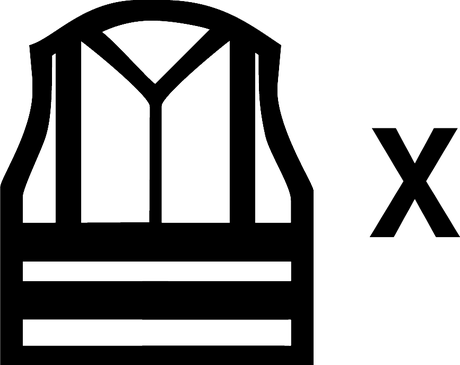
High visibility clothing bears the graphical symbol ISO 7000-2419, followed by the standard and the class – for example EN ISO 20471 class 2. The number next to the symbol – shown in the pictogram as X – indicates the garment class and depends on the amount of visible material, made up of background and reflective material. Only three colours are permitted as fluorescent background material: yellow, orange-red and red, each combined with retroreflective bands.
The three classes
Formally, the standard assigns the class on the basis of minimum areas of visible material. Which class your job requires depends on the hazard – and that depends on two factors: the speed of the traffic and the question of whether the person is an active road user or has their attention on their work (passive). The classes apply to passive road users; the standard gives this allocation as guidance in its annex:
| Class | Hazard | Typical use |
|---|---|---|
| 3 | Traffic above 60 km/h, attention on the work | Motorway, trunk road, track construction |
| 2 | Traffic up to 60 km/h, attention on the work | Built-up areas, construction site traffic, municipal services |
| 1 | Traffic up to 30 km/h, attention on the work | Company premises, warehouses, indoor areas with forklift traffic |
The annex to the standard classifies two situations as medium risk: people with their attention on the work at up to about 15 km/h – and active road users at up to 60 km/h. There it calls for “enhanced visibility” without specifying a particular standard. In practice, this is the domain of enhanced visibility equipment to EN 17353, whose own annex adopts the same risk table. Local factors can raise the classification: weather, low contrast with the surroundings, high traffic density.
Minimum areas – this is where it gets specific
Each class requires a minimum area of both materials, measured on the smallest size available. This is the point at which many misjudgements arise: a jacket that meets class 3 in XL does not automatically do so in S.
| Material | Class 1 | Class 2 | Class 3 |
|---|---|---|---|
| Fluorescent background material yellow, orange-red or red |
0.14 m² | 0.50 m² | 0.80 m² |
| Retroreflective material | 0.10 m² | 0.13 m² | 0.20 m² |
| Combined-performance material fluoresces and reflects at the same time |
0.20 m² | not applicable | not applicable |
| Corresponds to band length at 50 mm width – a calculated aid, not a value from the standard |
2.0 m | 2.6 m | 4.0 m |
What matters in practice
Meeting the standard is not the same as being clearly visible
The standard regulates the design in detail: bands must encircle the torso, may be inclined by no more than ±20° to the horizontal and need at least 50 mm spacing. For jackets, however, it allows two routes – one horizontal torso band, in which case reflective bands running over the shoulders are mandatory, or two torso bands without shoulder bands. Both routes meet the standard; they are not equally visible.
Our KÜBLER REFLECTIQ jackets are consistently designed with shoulder bands. Compared with the two-band design without shoulder bands, this gives a considerably higher retroreflection value from an elevated position – exactly the perspective of a lorry or construction machinery driver. One of the two is seen better.
Wash cycles determine the replacement cycle
Fluorescence and retroreflection decrease over the period of use – through washing, UV exposure and mechanical stress. The standard defines minimum values that must still be achieved after the stated number of cleaning cycles. If the value falls below this, the garment must be withdrawn from service, regardless of what it says on the sewn-in label.
In practice this means: a defined replacement cycle belongs in a rental laundry contract. Anyone who withdraws high visibility clothing on appearance alone either replaces it too early – or leaves garments in circulation that no longer meet the standard. More on this on the page about industrial laundering to EN ISO 15797.
Soiling acts like one class lower
A soiled high visibility jacket loses fluorescence long before the material is worn out. For very dusty work, washing frequency is therefore not a matter of comfort but part of the protection.
Customisation: what is allowed on high visibility clothing
Company logos on high visibility clothing are permitted – but not without limits. Every application covers area, and area is what the standard requires. Anyone who prints over large areas can in effect pull a class 3 jacket down to class 2.
If the garment also carries EN 1149-5, stricter limits apply: non-dissipative attachments on the outside – these include labels, customer logos and reflective bands – are permitted up to 5 cm in width with no limit on length; wider applications are restricted to a maximum of 10 × 10 cm. Beyond that, test data are needed to show that no incendive discharges occur.
Because PPE category III may only be modified by the manufacturer – with notification to the test institute – multi-standard garments cannot simply be customised afterwards. For category II, the decision lies with the user, but remains bound by the limits of the standard. Get in touch with us before customising – not afterwards.
Which class do you need?
| Situation | Recommendation |
|---|---|
| Work on motorways, trunk roads or railway tracks | Class 3, as a rule as a jacket + trousers combination |
| Urban construction site, municipal services, waste disposal | Class 2 – consider class 3 for night work or poor visibility |
| Company premises, warehouse with forklift traffic | Class 1 or 2, depending on traffic density |
| Occasionally entering traffic areas | Enhanced visibility to EN 17353 may be sufficient |
| High visibility plus flame or arc flash risk | Multi-standard garments – EN ISO 11612 and IEC 61482-2 combined |
High visibility collections
69 styles from our collections are certified to EN ISO 20471 – mainly trousers and jackets, plus bib and brace trousers, shirts and vests. The links lead directly to the filtered selection.
Frequently asked questions
Is a high visibility vest over normal workwear enough?
For class 2 that can be sufficient; for class 3, as a rule, it is not – a vest does not offer the required 0.80 m² of background material. Also important: the vest must be worn closed, otherwise the effective area is reduced.
Does the class also apply to small sizes?
The minimum areas are tested on the smallest size available. A style therefore meets its class across all sizes for which it is stated – small sizes may carry a lower class. The label in the garment is what counts. And: home-sewn or shortened garments lose their certification.
Can I apply company logos?
Yes, as long as the required minimum areas are retained. For clothing that additionally carries EN 1149-5, the following applies to non-dissipative applications: up to 5 cm in width the length is unrestricted; wider ones are limited to a maximum of 10 × 10 cm. For PPE category III, only the manufacturer may make modifications.
When does high visibility clothing have to be replaced?
When fluorescence or retroreflection fall below the values in the standard – this happens through washing, UV light and soiling. Visual inspection alone is not enough, which is why a defined replacement cycle belongs in every rental laundry contract.
What is the difference from EN 17353?
EN ISO 20471 applies to high risk – work in moving traffic. EN 17353 covers medium risk, for instance at traffic speeds below 15 km/h, and allows considerably smaller areas, for example retrofittable reflective bands.
Advice on high visibility
Being seen is
not a matter of chance.
We will work out with you which class your hazard situation requires, how much area is needed for it and what you need to look out for with customisation and wash cycles.
Last updated: July 2026