
EN 14058 – Protection against cool environments
In short: EN 14058 applies to individual garments that protect against cooling of the body at temperatures above −5 °C – in other words, by far the most common case: autumn, winter, draughts, chilled areas. For temperatures below that, EN 342 applies, and that standard does not assess single garments but complete ensembles.
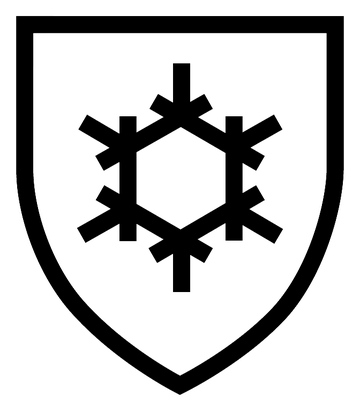
- The marking
- The snowflake in the shield identifies the garment as protection against cool environments – meaning the combination of air temperature (above −5 °C), humidity and wind. Next to the pictogram, the classifications achieved are given in a fixed order: the classes for thermal resistance and air permeability, supplemented, depending on the garment, by the measured Icler value and the resistance to water penetration.
The parameters – Rct is always mandatory, the rest depends on the claims made
| Parameter | Assesses | Status |
|---|---|---|
| Rct | Thermal resistance of the material | Mandatory, 4 classes |
| AP | Air permeability – wind protection | 3 classes – mandatory if outdoor use is claimed |
| WP | Resistance to water penetration | optional – in that case a minimum value of 8,000 Pa |
| Icler | Resultant basic thermal insulation | optional – mandatory for Rct class 4 |
The thermal resistance Rct is divided into four classes. It is given in m²K/W – the higher the value, the better the material keeps the warmth inside:
| Class | Rct in m²K/W |
|---|---|
| 1 | 0.06 ≤ Rct < 0.12 |
| 2 | 0.12 ≤ Rct < 0.18 |
| 3 | 0.18 ≤ Rct < 0.25 |
| 4 | 0.25 ≤ Rct |
In practice, alongside the Rct value, it is above all the air permeability that is decisive. Wind draws considerably more heat from the body than still cold air – an insulating but air-permeable material loses a considerable part of its effect in a draught.
EN 14058 or EN 342 – which applies when?
| EN 14058 | EN 342 | |
|---|---|---|
| Applies to | Individual garments | Complete clothing ensembles |
| Temperature range | above −5 °C | −5 °C and colder |
| Air permeability | optional | mandatory |
| Typical | Softshell jacket, bodywarmer, winter jacket | Cold store, frozen-goods logistics, winter construction |
The practical difference: under EN 14058 you can procure a single jacket. Under EN 342 the combination is assessed – jacket and trousers, where applicable with undergarments; single garments are measured there together with a defined reference clothing ensemble.
What matters in practice
Layering beats the thick jacket
Insulation is created by still air. Several thin layers hold more air than one thick one – and can be adapted to the activity. Anyone who sweats through a jacket that is too warm during physical work cools down all the more in the next break. Moisture is the biggest thief of warmth.
Movement changes the equation
The test values are determined on the material at rest. In motion, clothing pumps air through openings at the hem, sleeves and collar – the real heat loss is higher than the laboratory value. Adjustable closures are therefore not a minor detail.
Cold protection and high visibility often belong together
Anyone who works outdoors in winter is usually also out in poor visibility. Most of our cold protection styles therefore additionally offer high visibility to EN ISO 20471, and many also weather protection.
Collections for cool environments
12 styles from our collections are tested to EN 14058 – mainly jackets, plus bodywarmers.
Frequently asked questions
From what temperature do I need EN 342 instead of EN 14058?
The limit is −5 °C. Above it, EN 14058 applies to individual garments; below it, EN 342 applies to complete ensembles. In practice this means: cold stores and frozen-goods logistics to EN 342, normal winter work outdoors to EN 14058.
What does an X in the pictogram mean?
That this optional parameter was not tested – not that the result was poor. Only the thermal resistance Rct is compulsory for every garment – AP becomes mandatory if the manufacturer claims outdoor use, and the thermal insulation Icler for Rct class 4.
Is a thicker jacket automatically warmer?
Not necessarily. Insulation is created by still air, and several thin layers hold more air than one thick one. In addition: anyone who sweats through their clothing cools down faster afterwards. Moisture is the biggest thief of warmth.
Why is wind protection so important?
Wind draws considerably more heat from the body than still cold air. A material that insulates well but is air-permeable loses a large part of its effect in a draught. The AP value reflects this.
Advice on cold protection
It is not the thickest jacket
that keeps you warm the longest.
We will work out with you which parameters your activity requires and what a layering system looks like that you can actually work in.
Last updated: July 2026