
EN 13758-2 – UV protection through clothing
In short: EN 13758-2 governs when clothing may be marked as UV-protective. The key value is the UPF – measured in accordance with Part 1 of the series of standards. For people who work outdoors all the time, clothing is the most effective UV protection there is: it does not need to be reapplied and it works all day long.
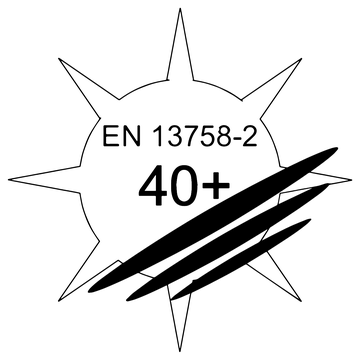
- The marking
- The standard provides for exactly one marking: UPF 40+. It may be used if the lowest UV protection factor measured is above 40 and UVA transmission remains below 5 % – EN 13758-2 does not provide for any higher claim.
What the UPF means
UPF stands for Ultraviolet Protection Factor. It describes what proportion of UV radiation passes through the fabric: a UPF of 40 means that about one fortieth gets through – the higher the value, the denser the protection.
What determines the value is fabric density, type of material, colour and finish – not thickness alone. A densely woven, dark fabric protects considerably better than a loose, light one. And: wet or stretched textiles let more radiation through than dry ones.
The marking – and a confusing peculiarity
Under EN 13758-2, UPF 40+ is the only – and therefore the highest – marking. This regularly leads to misunderstandings, because claims such as “UPF 50+” also appear on the market – these come from the Australian standard AS 4399 (published as AS/NZS up to the 2017 edition).
The European standard only knows UPF 40+. The Australian AS 4399:2020 grades more finely – 15, 30, 50 and 50+ – and awards its top rating “Excellent protection” from level 50; “50+” is only awarded there from a rated UPF of 55. A garment with “40+” under EN may reach the Australian top level, but does not have to. Anyone comparing offers where one states 40+ and the other 50+ is comparing two different systems of standards – not necessarily the same level of protection.
A UPF of over 50 was measured on our KÜBLER RESCUE clothing. That means: more than 98 % of harmful UV radiation is blocked by the fabric.
What matters in practice
Protection ends at the seam edge
A shirt with UPF 40+ protects exactly the area it covers. Neck, forearms, ears and the backs of the hands remain unprotected. For work with prolonged sun exposure, long-sleeved cuts, headwear and neck protection are part of the equipment – not as a comfort feature, but as a protective measure.
Wet is not the same as dry
Sweat-soaked or wet textiles let more UV radiation through. For physical work in the sun, a spare shirt is therefore not just a matter of comfort. The same applies to heavily stretched areas – for example over the shoulders – which protect less well than loosely fitting ones.
UV also works when it is cloudy
A considerable proportion of UV radiation penetrates clouds. Perceived temperature is no measure of UV exposure – which is why UV protection is also relevant on overcast summer days.
Skin cancer is a recognised occupational disease
Squamous cell carcinomas and actinic keratoses caused by natural UV radiation are recognised as an occupational disease in Germany. For employers, UV protection is therefore part of the risk assessment for outdoor work – not just a gesture of care.
Collections with UV protection
22 styles from our collections are tested in accordance with EN 13758-2 – shirts, trousers, jackets and sweatshirts.
Frequently asked questions
What does UPF 40+ mean?
That the lowest UV protection factor measured is above 40 – so at most around one fortieth of UV radiation gets through. UPF 40+ is the only marking EN 13758-2 provides for; the Australian AS 4399 grades more finely (15/30/50/50+) and awards “Excellent protection” from level 50.
Does UV-protective clothing replace sun cream?
For the covered areas, yes – and there it is more reliable because it does not have to be reapplied. Uncovered areas such as the face, neck, ears and backs of the hands still need sun cream or additional covering.
Does every shirt protect equally well?
No. Fabric density, material, colour and finish are decisive. A loose, light-coloured summer shirt can have a UPF of less than 10. Only tested clothing carries a reliable value.
Does clothing lose its UV protection when washed?
For textiles whose protection is based on fabric density and type of material, the effect is largely retained. Watch out for thinning and stretching: a worn-out or baggy fabric lets more radiation through.
Advice on UV protection
Covered skin is protected
more reliably than by cream.
We go through with you which articles offer tested UV protection and how to equip your outdoor teams for the whole season.
Last updated: July 2026