
EN 343 – Weather protection against rain
In short: EN 343 covers protective clothing against rain, snow, fog and ground humidity. Two properties are assessed: how tight the material is against water from outside (resistance to water penetration) and how well perspiration can escape to the outside (water vapour resistance). Both are given in four classes. Important to know: the standard has since been superseded by EN ISO 24232 – the requirements have remained unchanged.
Status of the standard and successor standard
| Previous edition | EN 343:2019 (DIN EN 343:2019-06) – withdrawn |
|---|---|
| Successor | EN ISO 24232:2025 (DIN EN ISO 24232:2026-05) |
| Parameters | Resistance to water penetration (Wp) and water vapour resistance (Ret), 4 classes each |
| PPE category | Category I – higher in combination with high visibility or multi-standard protection |
At standardisation level, EN 343 has been withdrawn and replaced by EN ISO 24232. In the Official Journal of the EU, however, EN 343:2019 is still listed as the harmonised standard – EN ISO 24232 does not appear there so far. The presumption of conformity is therefore still tied to the edition that no longer exists in standardisation terms.
In practice this means: markings to EN 343:2019 remain valid and legally correct. Anyone issuing a tender today should name both standards. The performance classes are identical in both – a change does not mean a different level of protection.
The minimum requirements for the tensile and tear strength of the outer fabric continue to apply unchanged – they were already added with the 2019 edition and assess mechanical durability, not just tightness.
Reading the marking
Weather protection clothing bears the pictogram with the umbrella, below it the standard and three items of information in a fixed order – for example 4/4/X or 3/3/R.
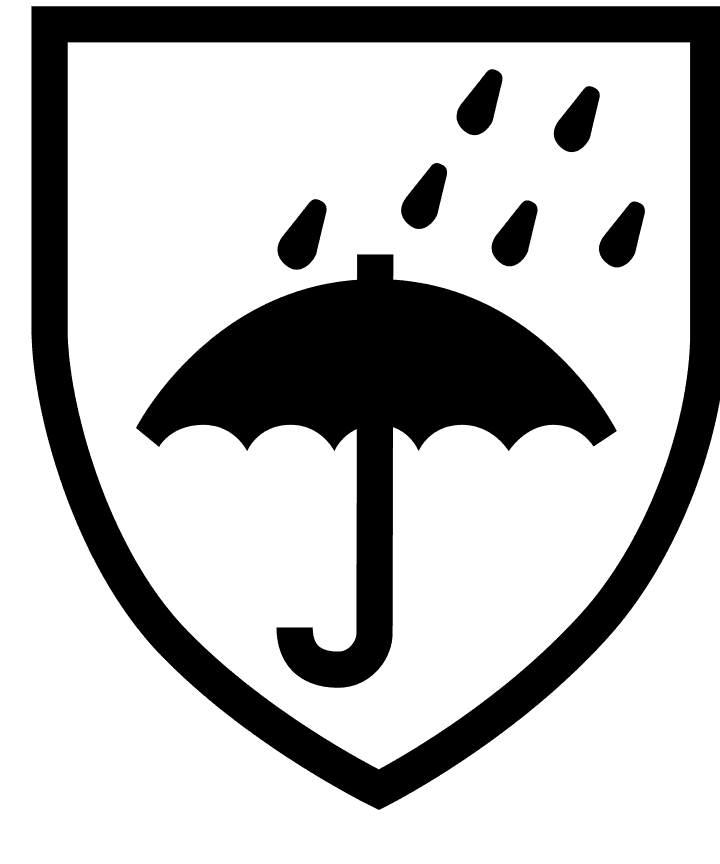
- First digit – resistance to water penetration (Wp)
- How tight the material is against water from outside. 4 = high protection, 1 = low protection.
- Second digit – water vapour resistance (Ret)
- How well perspiration can escape to the outside. 4 = very good moisture transfer, 1 = low moisture transfer. Note: for the Ret value itself, lower is better – the class reverses this.
- Third position – R or X
- R means: the finished garment was tested in the rain tower, not just the material. X means: not carried out. This test is optional – an X is not a defect, an R is a plus.
The classes at a glance
| Class | Resistance to water penetration Wp | Water vapour resistance Ret |
|---|---|---|
| 1 | ≥ 8,000 Pa, without pretreatment | > 40 m²Pa/W – low moisture transfer |
| 2 | ≥ 8,000 Pa, after pretreatment | over 25 to 40 m²Pa/W |
| 3 | ≥ 13,000 Pa, after pretreatment | over 15 to 25 m²Pa/W |
| 4 | ≥ 20,000 Pa, after pretreatment | ≤ 15 m²Pa/W – very good moisture transfer |
The pretreatment from class 2 upwards is the real endurance test: the value must be achieved after each of the four pretreatments in the standard – cleaning (according to the manufacturer's instructions, otherwise five wash cycles), abrasion, repeated flexing, and contact with fuel and oil. A material that is only tight when unwashed does not get beyond class 1.
What matters in practice
What counts is the margin above the standard's limit, not just passing
Class 4 requires a resistance to water penetration of 20,000 Pa – this corresponds to a water column of around 2,040 mm. What our hardshell jackets actually deliver, measured on the material:
| Test condition | Standard (class 4) | KÜBLER hardshell | Softshell |
|---|---|---|---|
| Material, untreated and after 5 cleaning cycles | ≥ 2,040 mm | ≥ 20,000 mm | ≥ 10,000 mm |
| Material after 30 cleaning cycles | — | ≥ 18,000 mm | — |
| Seams, after 5 cleaning cycles | ≥ 2,040 mm | ≥ 2,040 mm | — |
| Seams after 30 cleaning cycles | — | ≥ 2,040 mm | — |
The combination trap: two layers cost breathability
Hardshell over softshell sounds like more protection – and in terms of tightness it is. With breathability, however, the opposite happens. Measured after 30 cleaning cycles:
| Configuration | Ret after 30 cycles | Class |
|---|---|---|
| Hardshell jacket alone | 11.10 m²Pa/W | Class 4 |
| Hardshell + softshell combined | 34.11 m²Pa/W | Class 2 |
The Ret value triples, the class drops from 4 to 2. Anyone who wears both layers in continuous rain while doing physical work gets wet from the inside instead of from the outside. That is why our hardshell jackets state both: class 4/4/X alone and class 4/2/X in combination with the softshell jacket – so that it is clear in use what the combination really delivers.
What keeps a jacket tight is not in the test report
- Welded seams. Every seam is a hole in the material. Only welding makes it tight – and only that lasts through the cleaning cycles.
- Water-repellent zips. The longest continuous gap in a jacket is the front closure.
- Wicking barrier at hem and sleeves. Without it, the fabric draws water up from below – the membrane stays tight, but the wearer still gets wet.
- 2- or 3-layer laminate. Determines whether the membrane is protected by a lining or rubs directly on the inside.
Which class do you need?
| Use | Recommendation |
|---|---|
| Short distances between buildings, occasional showers | Class 2 or 3 is enough. With short wearing times, breathability hardly matters. |
| Outdoors all day, physical work | Class 4 for both values. Anything below that leads to moisture from the inside during exertion. |
| Rescue services, emergency responders | Class 4/4 plus high visibility. Here the combination with EN ISO 20471 comes in – and the clothing must be suitable for disinfecting reprocessing. |
| Continuous rain, stationary work | Pay attention to the seam value and the rain tower test. An “R” in third position shows that the finished garment was tested, not just the fabric. |
Interaction with other standards
- EN ISO 20471 – high visibility: The most common combination. Rain protection alone is PPE category I; with high visibility it becomes category II.
- EN 14058 – cool environments: For temperatures above −5 °C. Weather protection protects against wet, not against cold.
- EN ISO 15797 – industrial laundering: Crucial when the clothing goes through a textile service. Membranes measurably lose performance over the cycles.
- IEC 61482-2 – arc flash: At energy suppliers, weather protection is usually found as a multi-standard version.
Weather protection collections
16 styles from our collections are tested to EN 343 – from the weather parka to the multi-standard weather bib and brace trousers. Which one suits you depends on what else you have to deal with besides the rain.
You can also find an overview of all weatherproof products under weather clothing and winter & weather jackets.
Frequently asked questions
Does EN 343 still apply now that it has been withdrawn?
Yes. EN 343:2019 is still listed as a harmonised standard in the Official Journal of the EU, so the presumption of conformity continues to apply. Markings to EN 343:2019 are valid. In parallel, EN ISO 24232 already applies at standardisation level – with identical performance classes.
What does the X in the marking mean?
That the optional rain tower test on the finished garment was not carried out. In that case the material was tested. An R in this position means that the complete garment was tested in the rain tower.
Waterproof and breathable – can you have both at once?
Yes, that is what membranes are for. A water droplet is about 20,000 times larger than the pores of a membrane: water cannot get in, water vapour can get out. The system still has its limits – under heavy physical exertion, more perspiration is produced than any membrane can transfer.
Why does my rain jacket lose its water repellency after a while?
Usually the membrane is not defective; rather, the water-repellent finish on the surface has been washed out. The outer fabric becomes saturated and the jacket feels clammy inside even though it is tight. Reproofing generally restores the function.
Is class 3 enough instead of class 4?
For short distances and occasional showers, yes. For all-day use in the rain and physical work, class 4 for both values is the right choice – especially for the second value, which determines breathability.
Advice on weather protection
Staying dry is a
matter of the right class.
We will work out with you which class your job really needs, whether high visibility or multi-standard protection has to be added and what you should look out for with seams and combinations.
Last updated: July 2026