
EN 17353 – Enhanced visibility equipment
In short: EN 17353 applies to medium-risk situations – where people need to be seen but are not working in moving traffic. It requires considerably smaller areas than EN ISO 20471 and distinguishes by types instead of classes: depending on whether the hazard exists in daylight, in darkness or in both.
The three types
The type is determined by the time of day at which the hazard exists. The standard still requires minimum areas – graded by type and body height, just considerably smaller than for high-visibility clothing:
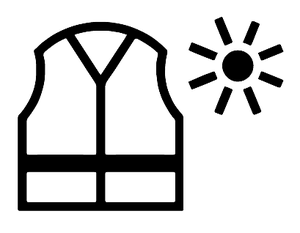
- Type A
- The risk of not being seen exists only in daylight. Only fluorescent material is used to enhance visibility.
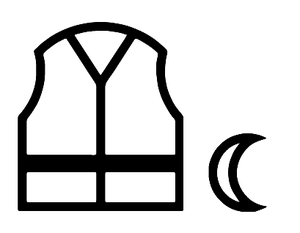
- Type B
- The risk of not being seen exists only in darkness. Only retroreflective material is used to enhance visibility.
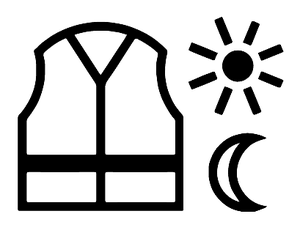
- Type AB
- The risk of not being seen exists in daylight, twilight and darkness. Fluorescent and retroreflective materials are used to enhance visibility.
Type B is further subdivided – depending on where the material is located and whether it makes a movement or a human form recognisable: B1 (free-hanging products), B2 (on arms or legs) and B3 (on the torso, or torso plus limbs). A single reflective band on the arm shows that something is moving there; only several encircling bands make a person recognisable as such. Since the 2020+A1:2025 edition, type AB has also been subdivided accordingly – into AB2 and AB3.
EN 17353 or EN ISO 20471?
| EN 17353 | EN ISO 20471 | |
|---|---|---|
| Risk | medium | high |
| Typical | Traffic below 15 km/h, company premises, forest | Work in moving traffic |
| System | Types A / B / AB | Classes 1 / 2 / 3 |
| Areas | considerably smaller | up to 0.80 m² background material |
The threshold is a traffic speed of around 15 km/h. Below that, there is only a medium risk, even for people who are not actively taking part in traffic. Local factors can raise this: poor weather, low contrast with the surroundings, high traffic density.
What matters in practice
Enhanced visibility is not watered-down high visibility
Anyone working in moving traffic needs EN ISO 20471 – highly visible equipment to EN 17353 does not change that. The standard is intended for situations in which high-visibility clothing is not mandatory but visibility still saves lives: in the forest, in the depot yard, during maintenance work away from the carriageway.
Retrofitting is possible – within limits
Equipment to EN 17353 can in part be retrofitted, for example as reflective tape on existing clothing. Important: for dissipative clothing to EN 1149-5, tight limits apply to non-dissipative attachments – up to 5 cm wide with no limit on length, wider ones no more than 10 × 10 cm in area.
Enhanced visibility equipment
For work in moving traffic, the route leads to high-visibility clothing to EN ISO 20471.
Frequently asked questions
What is the difference between type A, B and AB?
Type A uses only fluorescent material and works in daylight. Type B uses only retroreflective material and works in darkness. Type AB combines both and covers daylight, twilight and darkness.
Does EN 17353 replace high-visibility clothing to EN ISO 20471?
No. EN 17353 applies to medium risk. Anyone working in moving traffic needs high-visibility clothing to EN ISO 20471 with its considerably larger minimum areas.
When is enhanced visibility sufficient?
As a guide, a traffic speed below around 15 km/h applies. Local factors such as weather, low contrast or high traffic density can raise the classification – the risk assessment decides.
Advice on visibility
Seeing movement and recognising
a person are two different things.
We clarify with you whether enhanced visibility is sufficient for your situation or whether high-visibility clothing to EN ISO 20471 is required.
Last updated: July 2026